
According to the American Library Association (ALA), early literary skills are the “natural development of skills through the enjoyment of books, the importance of positive interactions between babies and parents, and the critical role of literacy-rich experiences” (ALA, 2009). Literacy development begins at birth and is connected to early experiences with books and stories. Babies learn language through literary experiences such as parents or caregivers interacting with them through books (ALA, 2009).

In the textbook Storytimes for Everyone! Developing Young Children’s Language and Literacy (2013), authors Ghoting and Martin-Diaz discuss five practices to introduce early literacy skills, including singing, talking, reading, writing, and playing. Librarians can incorporate these skills into storytime and other programs. Talking to children is important to develop their oral language skills. Adults should talk a lot, incorporate gestures, and use a variety of words (Ghoting, 2013). Singing can add to a child’s vocabulary and help develop phonological awareness. Words in songs are often separated into syllables, and songs slow down the pronunciation of words (Ghoting, 2013). Reading aloud to children is said to be the most important activity for children’s success as readers. Reading helps build vocabulary, alphabetic knowledge, and background knowledge. Writing is important for children to understand the relationships between letters and sound. Play supports support children’s language and literacy development and help develop higher thinking skills, imagination, and problem-solving abilities (Ghoting, 2013). (See section below on The Importance of Play).

In a study performed by the National Early Literacy Panel in 2008, alphabet knowledge, phonological awareness, and oral language were identified as having the most positive impact on a child’s ability to read and write (Ghoting, 2013). More than one in three American children start Kindergarten without the skills necessary to learn to read (Raising Readers, 2020). Developing early literacy skills makes it easier for children to learn to read, helping them to succeed in school and in life.

According to Jalongo (2015), parents should be encouraged to make reading a high priority at home. Parents should be role models by reading for themselves. Reading aloud should be relaxed and enjoyable and involve all members of the family. Children should have access to a wide variety of books. Reading and sharing picture books is a predictor of children’s success in literacy.
By incorporating early literacy skills and principles into storytime and other programs, librarians can help young children develop the skills needed to succeed.
Storytime
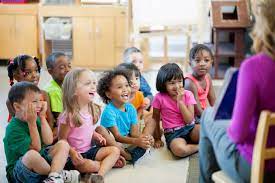
Storytime for children is a staple at most public libraries. Not only is it a source of entertainment, storytime offers many benefits for children, such as early literacy skills and social interactions. As stated above, there are five practices to introduce early literacy skills, including singing, talking, reading, writing, and playing. In addition, Ghoting and Martin-Diaz (2013) discuss five early literacy components. These include:
- Phonological awareness- the ability to hear and play with sounds in words, recognizing environmental sounds, the ability to hear syllables,, and rhyming. This component is critical to sounding out words when reading.
- Print conventions and awareness-the concept that print has meaning and understanding that print is all around us. Understanding how to handle a book is part of this component.
- Letter knowledge- Knowing that the same letter can look different and that letters have names and represent sounds.
- Vocabulary– Knowing the meanings of words.
- Background knowledge– refers to prior knowledge, or what children know before entering kindergarten.
Librarians can incorporate these practices and early literacy components into storytimes for children of all ages.
Enhanced Storytime
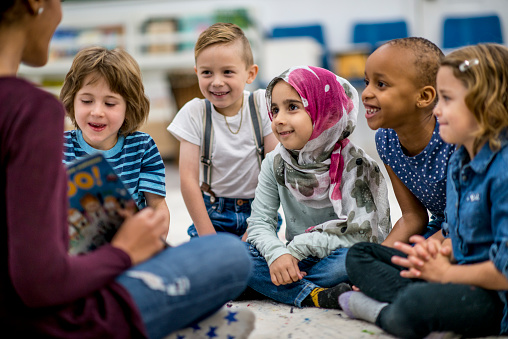
Enhanced storytimes incorporate early literacy components, practices, and research into the storytime. Parents/caregivers can be given three tips, or asides, that demonstrate the connection between what the children are doing at storytime and reading. They can also be given information on how to support early literacy at home. According to Ghoting and Martin-Diaz (2013), one literacy component should be highlighted at each storytime. There are three types of tips or asides: explain, example, and empower. Explain is a short example of the literacy component that will be highlighted during that storytime. Example points out the practice that is part of the storytime and its connection to early literacy. Empower suggests how to continue supporting the literacy component at home (Ghoting, 2013). Handouts can be given to the adults to reinforce what is discussed during storytime.
Informational Books
Informational books are defined as books that teach children information about the world around them. They usually contain photos or illustrations and are written by experts in the field. Informational books can be beneficial since they expose children to more vocabulary, and children are asked more questions than when reading narrative books. Jalongo (2015) states that the use of informational books helps children transition to using textbooks when they are in third or fourth grade. According to Ghoting and Martin-Diaz (2013), informational books should be included in storytime for children ages two and up. Presenters can incorporate hands-on activities and show caregivers how to use informational books at home. Children should be given an opportunity to ask their own questions about informational books. This can help increase their vocabulary, content and background knowledge which is crucial to academic success.
Some scientific and mathematical concepts can be incorporated into storytime for young children. These include sorting, measuring, predicting, counting, problem solving, learning sizes, shapes, and patterns, and many more. Hands-on activities during and following storytime can help illustrate and enhance these concepts (Ghoting, 2013). Narrative books can be used in storytime in conjunction with informational books to enhance the experience.
The Importance of Play
Play is essential to the social development of children and early literacy skills. According to Ghoting and Martin-Diaz (2013), play is one of the five practices, along with talking, singing, reading, and writing, that lead to a strong foundation in early literacy. Symbolic and dramatic (pretend) play support children’s language and literacy development and help develop higher thinking skills, imagination, and problem solving abilities. Play allows children to learn to cooperate, take risks, experience fear, and develop other skills needed for adulthood.
The amount of time for free play for children has dropped dramatically in the past few years. Many parents are concerned that their children get into the right colleges and are more focused on structured, organized, school-like activities than imaginative, creative play. Most psychologists agree that free play is critical for children to become socially adept, cope with stress, and develop problem solving skills (Wenner, 2009). Free play for children can involve fantasy, such as pretending to be princesses, doctors, playing house, or play fighting such as wrestling or tumbling. Free play should be voluntary, in a relaxed setting, and have no clear goal (Wenner, 2009).
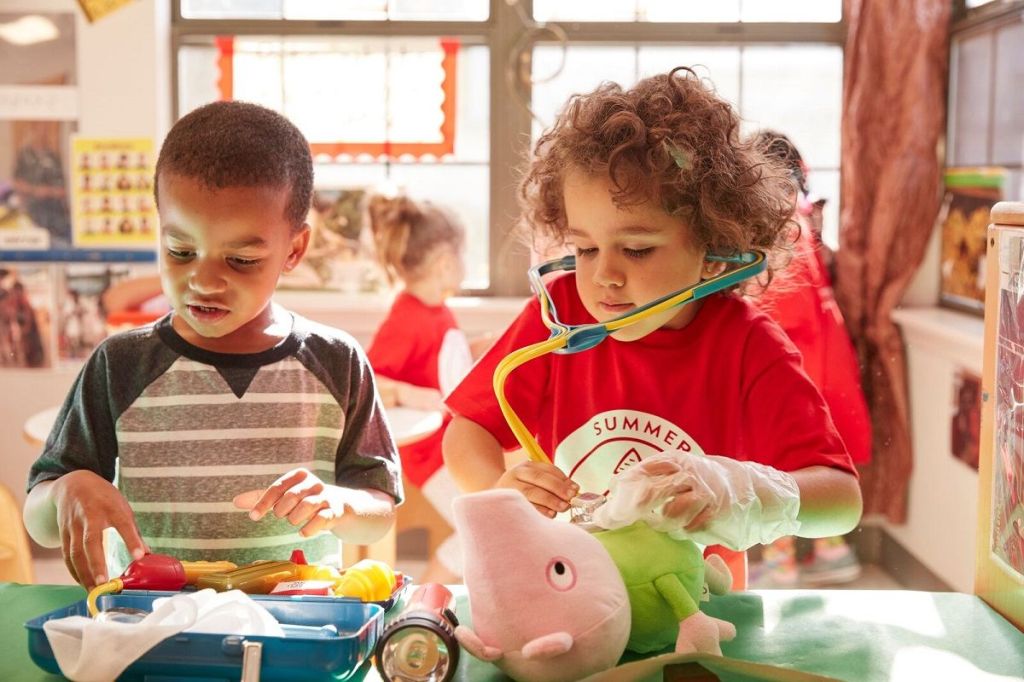
One of the important aspects of free play is that it helps develop social skills by interacting with peers and learning what is and is not acceptable. Children learn how to play fair and take turns. Free play can also help develop persistence, negotiating skills, and communication skills. Studies show that children use more sophisticated language when playing with other children than with adults. In imaginative play, children might need to describe something that is not present and use language skills and contextual clues to communicate their message (Wenner, 2009).
According to Alharbi and Alzahrani (2020), children can learn to read, write, and use math and science concepts through play. Many studies show that play is effective in teaching these areas. When children act out stories in dramatic play, it helps to increase their comprehension of the story. Play helps children put things in order and develop a sense of numbers. Playing with science can help children learn problem-solving and creative thinking. Play can also help with personality development and self-image.
According to Jalongo (2015), children’s language skills develop best in natural settings, such as play-based experiences. Props, literacy materials, and repeatedly reading the same books can add to children’s understanding of books, and “build a bridge between play and language.” Print materials can be added to children’s play, such as putting up signs and labels in children’s play areas. Jalongo (2015) states that children can use props to act out parts of stories. They can also read parts of stories in unison during storytime.
Children enjoy unstructured playtime, and the benefits of it outweigh the consequences of not having any. Children who are deprived of play at a young age can develop personality disorders and become socially inept and maladjusted. Play should be an intrinsic part of all early childhood learning. Librarians can offer play-based programming and free play time after storytime to help young children receive the benefits of play.
References:
Alharbi M. & Alzahrani, M. (2020). The importance of learning through play in early childhood education: reflection on The Bold Beginnings Report. International Journal of the Whole Child Vol.5 No 2. Retrieved from https://files.eric.ed.gov/fulltext/EJ1286551.pdf
American Library Association. (2009, February 25). Early literacy. Retrieved from http://www.ala.org/united/products_services/booksforbabies/. Doi 83af9eec-e43c-cdd4-ad1d-c8316bd8a36c
CECE Early Childhood Videos at Eastern CT State U. (n.d.). Importance of play. [Video]. YouTube. Retrieved from https://www.youtube.com/watch?v=vnH4Ijen7OI
ECETP. (2018, June 8). Play-based learning with Dr. Peter Gray. [Video]. YouTube. Retrieved from https://www.youtube.com/watch?v=wJaAegok8L4
Ghoting, S.N. & Martin-Diaz, P. (2013). Storytimes for everyone! Developing Young children’s language and literacy. ALA Editions.
Jalongo, M. R. (2015). Literacy for all young learners. Gryphon House Inc. Kindle edition.
Kindercare. (2018). Pretend play. [Photo]. Retrieved from https://www.kindercare.com/content-hub/articles/2018/march/pretend-play-stuffed-animals
Mrs. Tempel’s Storytime. (2020, November 11). Read aloud- baby animals | nonfiction animals. [Video]. YouTube. Retrieved from https://www.youtube.com/watch?v=bfKtD4zbPBE&t=17s
Raising Readers. (2020). What is early literacy. Retrieved from https://www.raisingreaders.org/understanding-early-literacy/establishing-early-literacy/
Scholastic. (2021). Pretend play. [Photo]. Retrieved from https://www.scholastic.com/parents/kids-activities-and-printables/activities-for-kids/arts-and-craft-ideas/importance-pretend-play.html
Wenner, M. (2009). The serious Need for play. Scientific American Mind, 20(1), 22–29. https://doi.org/10.1038/scientificamericanmind0209-22
 Deb's Early Childhood Literacy Program